6/26/08
I
was reading the Globe All-Scholastic pages from last Sunday's
paper. It reinforced my bias that track individuals are
smart. Fourteen Phelps Scholar-Athletes were honored and
seven of them were track athletes, six having track as their
major sport. This considering the award is chosen from a
list comprised of every sport over all three seasons.
Maybe
some people rush past the page and head directly to their
spring sport of choice. But I've watched this list closely
ever since Emily won the award in 1997 to go with her spring
track Golbe All-Scholastic.
These are some pretty amazing student/athletes. Harvard
bound Shannon Conway ran 55 in the 400M dash this spring
while becoming state and New England champion. Laura Stern
was runner-up in the New England meet javelin with a throw
of over 146' in jav, eclipsing the meet record she set last
year. Patrick Rutan is not only a cross country standout
for Algonquin Regional, but he also scored three 800's on
the SAT's. He's headed to Yale. You get the idea!
Among
Hock tracksters nominated for this award were Ben Harris
(FX), Frank May (FR), Jessica Pickett (OA), Caileigh Grove
(FR), and Elizabeeth Sullivan (MN).
I
also noticed some interesting stats on the spring sport
All-Scholastic teams. KIng Philip was represented
in the most sports (3) with softball, boy's' lacrosse and
girls' lacrosse. Franklin had a baseball player, Andrew
Leenhouts. If the name sounds familiar, his sister has graced
these pages often as a distance runner for the Panthers
and Yale.
But
not surprisingly, track is where the Hock had its most representatives.
On the boys' side there was Matt Callanan (110MH) and Mike
McPherson (SP) of Mansfield and Nick Wade (800M) of North
Attleboro. Those two teams were also represented on the
girls' side. Meghan Ferreira led the Hornet selection in
both 100MH and 4X400 where she was joined by Michelle Jenssen,
Emily Broyles and Katie Jenkins. The Rocketeers 4X100M of
Julianne Cappadona, Kristen McLoughlin, Katy Flannery and
Carolyn Udall were also honored. All those athletes are
to be commended for the state-wide recognition they've brought
to their schools.
6/15/08
The
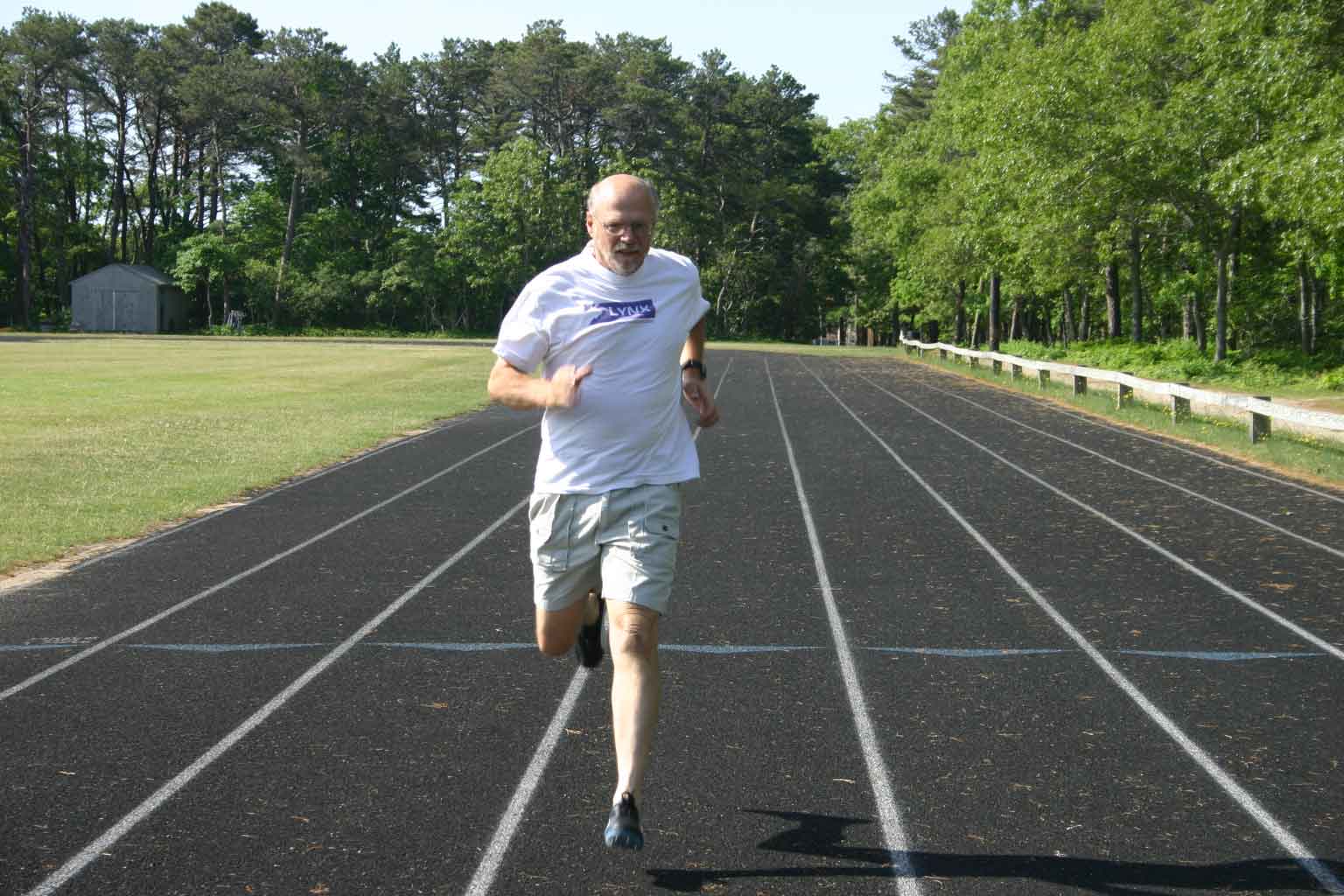
last time I won the 100M dash was the Hock Championship
in 1970. Actually, back then it was 100 yds. My collegiate
career at UCONN went in a different direction as I concentrated
on the high jump and triple jump. Yet, on Saturday I got
to do something that made me yearn for the days of blasting
out of the blocks and leaving competition in the dust. I
got to don a set of spikes that has covered 100M faster
than any other. The spikes on my feet had gone 100M in 9.72,
courtesy of Usain Bolt when he set the world record! This
week they'll be leaving the US - probably for the last time.
But, for just a few minutes they were flying down the straightaway
of Nauset's track powered by my own sinew. I won't say how
much slower they were moving than they were on Randall Island's
track. Suffice to say, it felt a lot faster than it was.
6/8/08
It
would be fair to say that I'm interested in excellence.
People are capable of exhibiting their passions in profound
ways that engage and even inspire others. I enjoy seeing
it, applauding it and if possible, cultivating it.
Running
was a passion of mine from the very start, eventually morphing
into a life-long fascination with track and field. That
makes it a natural tendency for me to understand and appreciate
track athletes and coaches. Watching them in action tells
me most of what I have to know about them.
It
would have been usual for me to be at the Massachusetts
state finals on Saturday. Last week I posted my yearly preview
for the finals and it fired me up to see the great competition
about to unfold. Better yet, for North Attleboro fans both
Nick Wade and the girls' 4X100M relays were chasing school
records and Massachusetts' championships - successfully.
I usually don't miss things like that!
But
since retirement from coaching, I've begun to make up for
lost time in a few of the other important areas of life.
Committing to the coaching profession has caused me to miss
countless family weddings, birthdays, funerals, showers
etc. Arlene has gone solo in my spot so often she has become
the living definition of “track widow”.
So,
instead of hanging out at Durfee, Saturday I attended a
memorial service in Contoocook, New Hampshire (Tooky) for
Aunt Gert. She passed away over the winter at the age of
94. By 11:AM it was the type of hot where thinking makes
you sweat, and our small gathering clustered in the shade
of tall pines. The reverend spoke in simple terms, urging
us to celebrate rather than mourn and to find comfort in
passages from the Bible.
He
admitted that he hadn't known Aunt Gert and did his best
to personalize the service. He meant well, and by complete
measure he did well, but he used just one word that was
misplaced. He used the word “common” as in a common life.
Perhaps in rural New Hampshire it is a compliment, but I
can't agree with the assessment.
Maybe
using words such as simple and plain is the way people who
lived full lives in rural America like to represent themselves
to those from away. But Aunt Gert's life was anything but
common.
She
was born before World War 1, the second child in a family
that grew to include ten children – including
my father Ervin and his twin brother Elwin. Aunt Gert was
a teenager of the roaring twenties. She married Raymond
Bradbury, entering adulthood as a young wife during the
Great Depression. I never saw in her the scars of those
times, or the terrible tragedy of losing a child at age
4 to drowning. Those were so long before I was born that
they had weathered with time. As the world grew and her
siblings started to move throughout the country, Gert kept
her home in Warner, New Hampshire close to her parents.
As
I was growing up, my family would squeeze into a little
red Fiat to visit Nanna and Grampa. We always had to stop
at Gert's. This is in the days before television became
the babysitter of choice. I can't even remember if she had
one. Instead, we would sit around the kitchen until we got
the word that it was OK to walk down to the river.
We
would walk with dad across a covered bridge that looked
like it was ready to tip at any moment and drop us into
the river. You could look down through holes in the floor
to see suckers and trout holding steady in the current 20'
below. On the return trip we'd take measured steps across
the railroad bridge, often wondering if one of us would
slip between the ties.
In
later years Aunt Gert became the matriarch of the Estey
side of our family. Perhaps her life was common in that
it held many of the joys and sorrows we all share, but across
a long life that multiplied both. She loved family, but
lived long enough to see her husband and seven of her siblings
pass before. As her body turned frail, it magnified just
how sharp her mind remained. Tucked away in this quiet corner
of New Hampshire, the world never left her behind. She always
asked that one question that made you realize she'd been
keeping up with your life from afar.
Despite
the countrywide stretch of her extended family, everyone
knew that Warner remained the hub. I fear with her passing
that it has all changed.
But
for this one day, Aunt Gert had us back together, just down
the road a piece from Warner, in that little hamlet of Tooky.
After the service, the picnic table and folding chairs came
out. We sat around under the pines munching on homemade
sandwiches, catching up on family news and telling a few
tales about Aunt Gert and Uncle Ray. At the end, one by
one we drifted back across the lawn to the gravesite to
say our final goodbyes. Who knows if we will ever all meet
up again?
On
the way home mom reminded Chris and I of the time Aunt Gert
made us picnic sandwiches for a trip to who knows where.
All we can remember is Dad stopping the car along a stream
where we jumped from rock to rock and ate sandwiches better
than you could ever buy in a store. It was one of those
days - so simple that it was impossible to ever recreate.
6/1/08
I
was thinking about Stephanie McNamara's performance at the
DIII nationals and it reminded me of the clear distinction
between the pursuit of success vs. trying not to lose. Three
weeks ago she hadn't even qualified for the race. She was
firmly at home on a plateau of 4:45ish 1500M races. It has
been a long freshman year of improvements in XC, indoor
track and spring track and it was reasonable to expect that
her season would come to an end. But as history has shown
many times, the most successful are seldom reasonable or
conservative in their expectations. That attitude may sometimes
reap heartache, but quite often it produces results of unpredictable
excellence.
Flash
back to 1988 - Lynn Liberatore as a sophomore in high school.
She was undefeated going into the final cross country dual
meet of the season, a match-up with another undefeated sophomore,
Lori Kelly of Foxboro. At the time we were running at the
Town Park and our course featured two trips up the sled
hill, the second climb just over a half-mile from the finish.
Entering that last hill Kelly pulled away and bounded up
the steep hill effortlessly for the easy win. As great as
Lynn was, it would have been easy to picture a scenario
where she spent the next two years as the league runner-up.
That wasn't what Lynn had in mind. Her expectations were
higher and she went about controlling the situation instead
of letting it control her. After a year of hard work, Lynn
came back in 1989 to beat Kelly, go undefeated and earn
the mantle of Hockomock MVP. She repeated in 1990.
Flash
to 1996 – Emily Estey at the New England Championships.
As a junior, Emily had placed third the previous week at
the State Finals in the 800M. In that race, with 200M to
go she made her move and entered the final straightaway
in first, only to be re-passed by two runners in the final
100M. Now, she was entering the New Englands seeded
fifth behind the two girls who had beaten her and two champions
from other states. I left the race strategy up to Emily
- figuring that the experience from the week before would
convince her to postpone her kick. If things fell right
she might even get a top-3 finish. Apparently she had no
designs on placing third. Instead, with 400M to go she moved
up through the pack and with 300M to go she was in the lead
and pulling away. Emily built up such a large lead that
even as she faded in the final 100M no one could catch her.
The result was a New England Championship.
Which
brings me back to Stephanie. Two weeks ago she broke 4:40
to qualify for Nationals and headed to Wisconsin. In the
trials on Thursday she raced 3:34.12 to qualify for Saturday
finals. Her e-mail to me will explain what happened next.
“Hey
Coach!
I
don't know if you've seen the results yet, but I'll tell
you anyways.... today at UW Oshkosh I placed 8th in the
1500 receiving All American honors!!!!! 4:32.03! The race
went out soooo hard. First 200 was a 30, 400 was a 65 for
the leaders (67 for me), 800 was a 2:15 for the leaders
(2:19 for me), 1200 for was around a 3:33/3:34. It
was crazy. Thank god I didnt hear any splits. I went out
in around 10th place and, at the time, because it went out
so hard, I felt like I just didnt have any other gears to
drop down to. (My plan was to get out hard to get a good
position, settle in, and then kick). Unfortunately when
you are moving at a 2:19 800 pace, there really aren't that
many more gears to switch to. But the pace slowed a bit
in the third lap which is when I made my move, and passed
a couple of girls. Anyways, I couldn't believe it. During
the race I really didnt think I could do it, but at some
point something clicked and I knew I was still in the race,
and I just went for it at the end. The trials were extremely
nerve-racking on Thursday as well. If the second heat had
gone out faster and run better than 4:37.xx I may not have
made it to the finals. This year's competition field for
the 1500 is the stiffest that Division III has ever seen.
I still can't believe how well the race played out though!
And now my freshman year has officially ended. Kind of sad...
but I can't wait till cross!”
Of
course, it is funny to hear her say she didn't think she
could do it because she had spent the week putting her mind
in the right place.
“P.S.
I cannot tell you how many times in these past few days
that I read through the articles that you wrote ("Deep",
"The Purest Sport," etc.) and the poem that you
wrote ("Only You"). Those words really helped
me to focus and to realize that, despite the stiffness of
the competition field that I was up against, I had the ability
and the strength to be just as competitive as any other
runner out on that track today.”
Yours
in running,
Coach
Estey